Swimming Pool Contractors in Karnataka
Building and maintaining pools across the state — Bengaluru, Mysore, coastal Mangalore and Udupi, the Coorg and Chikmagalur hill belt, and North Karnataka. Different regions need different engineering, and we quote them differently.
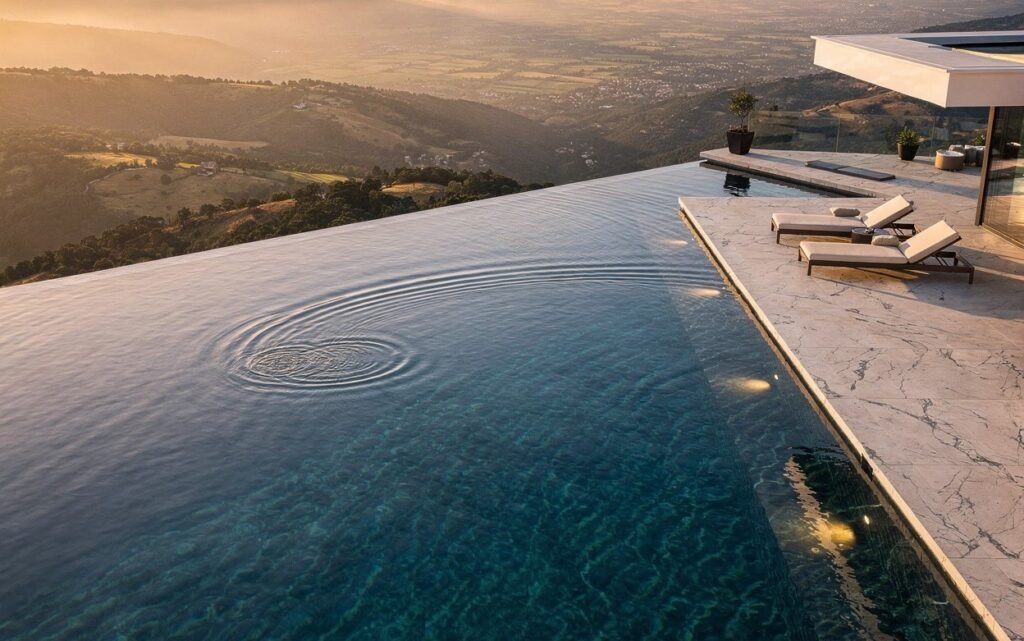
OceanPools builds RCC and fiberglass swimming pools across Karnataka, from Bengaluru villas to Coorg resort properties and coastal homes in Mangalore and Udupi. Pools cost roughly ₹2,000 to ₹5,500 per square foot of water surface, and take 8 to 14 weeks in concrete.
Where in Karnataka Is Your Site?
Karnataka is not one construction market. A pool on a Coorg coffee estate, a villa in Whitefield, and a beach house near Udupi have almost nothing in common beyond the water. The soil is different, the rainfall is different, the water chemistry is different, and the logistics of getting machinery to site are very different.
We quote each region on its own terms rather than applying a flat rate across the state.
Bengaluru & Surroundings
Whitefield, Sarjapur, Devanahalli, Kanakapura Road and the villa belt around the city. We have a dedicated page covering Bengaluru soil conditions, water table zones and local pricing.
Coorg, Chikmagalur & Sakleshpur
Homestays, boutique resorts and coffee estate properties in the Western Ghats. Steep terrain, very heavy rainfall, and sites that machinery cannot always reach easily.
Mangalore, Udupi & Coastal Karnataka
Beach villas, resorts and coastal homes. Salt-laden air, a high water table and some of the heaviest rainfall in India.
Mysore, Hubli, Belgaum & North Karnataka
Heritage properties, farmhouses and villas. Hot dry summers, high evaporation, and in parts of North Karnataka, expansive black cotton soil.
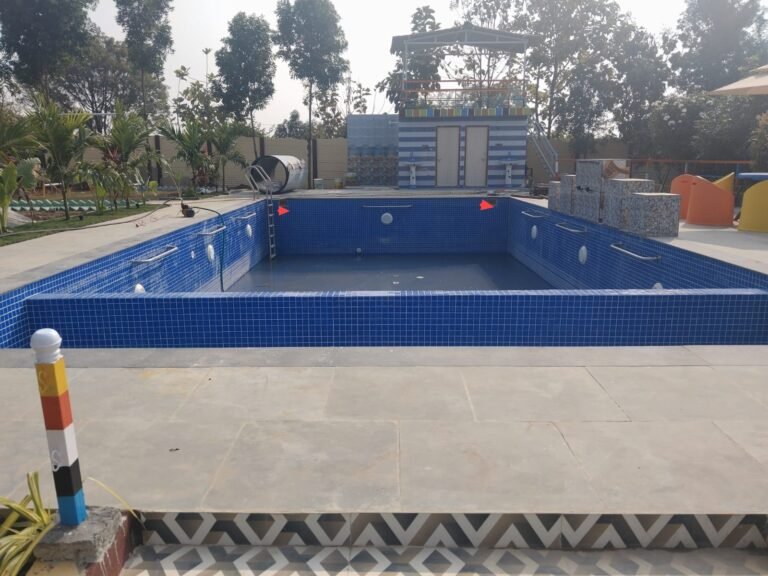
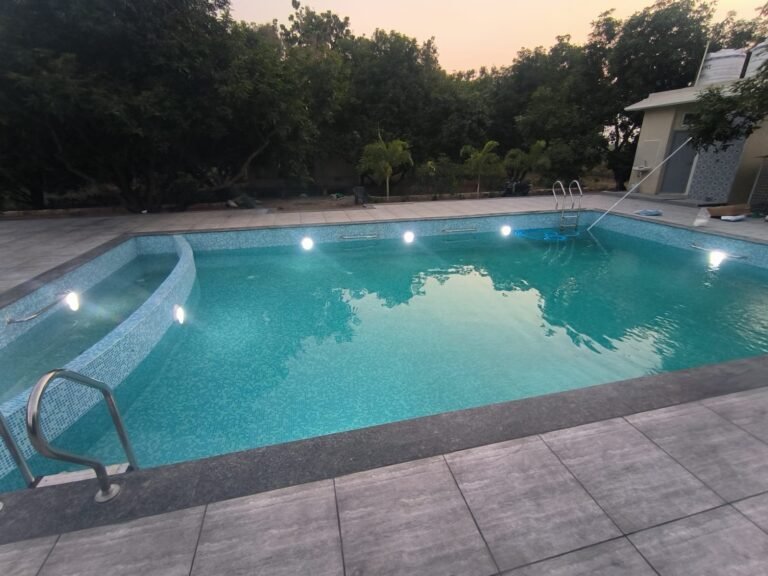
OceanPool Images
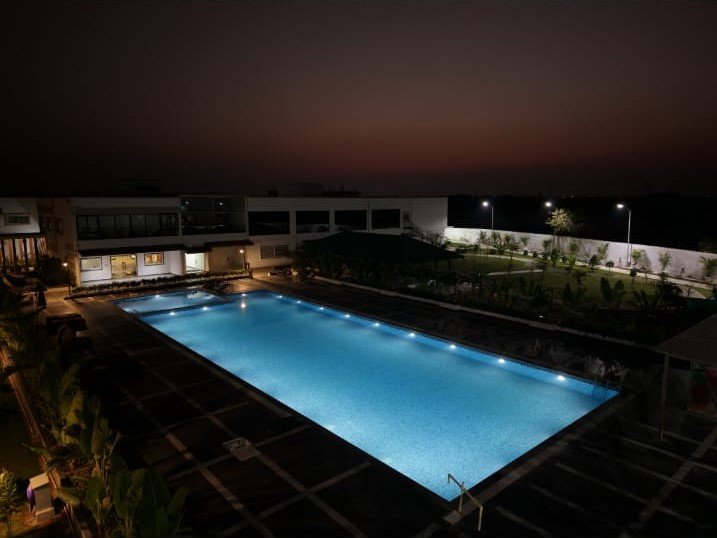
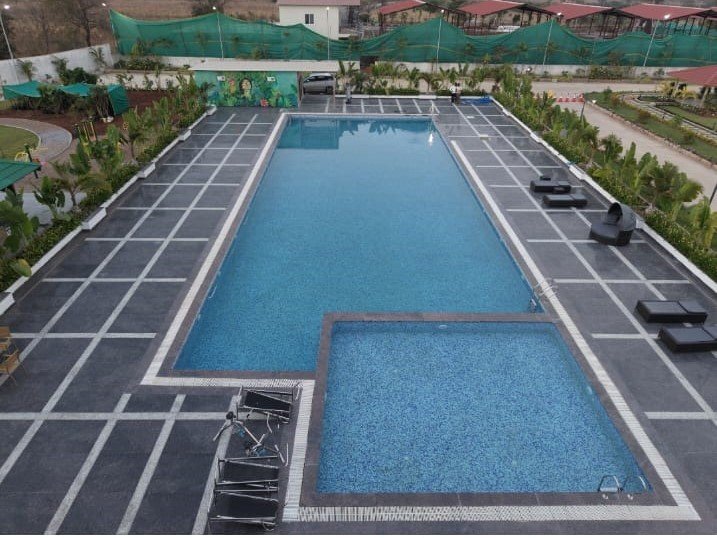
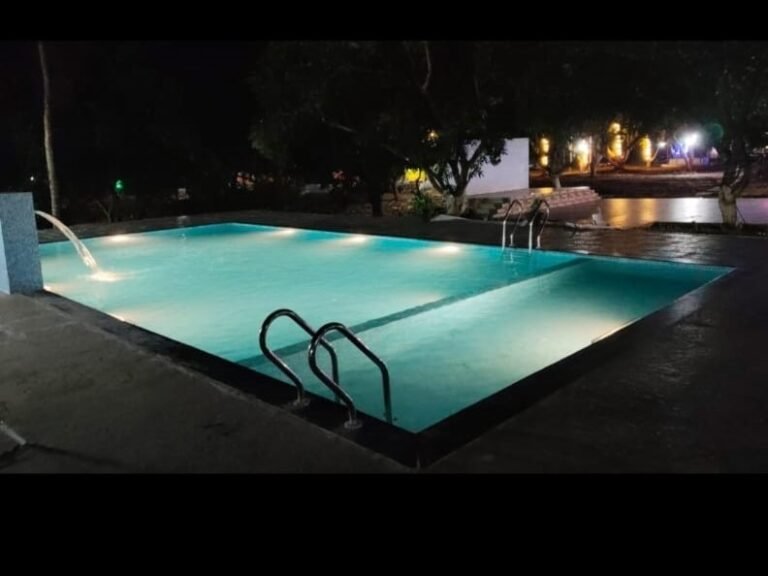
OceanPool Videos
Completed pool in Raichur Karnataka
Completed pool in Nizamabad
Completed pool in Moinabad
Completed pool in Sadasivpet
Completed pool in Sadasivpet
What Changes Across Karnataka
Coorg, Chikmagalur & the Western Ghats hill belt
This is the most demanding pool construction environment in the state, and also the most rewarding to get right.
Rainfall in Kodagu and Chikmagalur commonly runs between 2,500 and 4,000 mm a year, concentrated into a few intense months. That does three things to a pool project. Excavations flood and need continuous dewatering. Concrete curing schedules have to work around the weather rather than the calendar. And surface water running downhill has to be diverted around the pool shell, not allowed to collect behind it, or the hydrostatic pressure will eventually find a weakness.
Most hill sites also slope. A pool on a slope needs retaining structure on the downhill side, and that retaining work is frequently a larger line item than
the pool itself. A contractor who quotes a hill site at flat-land rates has not looked at the site properly.
Access is the third factor. Coffee estate and homestay properties often sit at the end of narrow, unpaved approach roads. Whether an excavator can physically reach the pool location, and whether a concrete mixer can, changes both the method and the cost. We check this on the site visit before we quote, because finding out afterwards is expensive for everyone.
For resort and homestay owners specifically: we plan the build around your occupancy calendar. A pool finished in October is worth considerably more than the same pool finished in January.
Mangalore, Udupi & coastal Karnataka
The coast brings three conditions that inland pools never face.
The first is salt. Salt-laden air corrodes pumps, filters, light fittings, deck hardware and railings far faster than inland installations. Standard equipment that lasts eight years in Bengaluru may last three near the shore. We specify marine-grade or properly coated hardware for coastal sites and design the
equipment room to keep salt air out of the electricals.
The second is the water table. Coastal Karnataka sits on sandy and laterite soil with ground water that can be close to the surface, especially after the monsoon. This matters more than people expect. During construction the
excavation needs dewatering. After construction, an empty pool can float —hydrostatic pressure lifts an unweighted shell upward. The fix is a hydrostatic relief valve and proper perimeter drainage, and it costs very little at the design stage and a great deal afterwards.
The third is rainfall. Mangalore and Udupi receive some of the highest annual rainfall in India. Deck drainage, overflow capacity and dilution of pool chemistry all have to be designed for it rather than added later.
Mysore & southern Karnataka
Mysore’s conditions sit between Bengaluru and North Karnataka — moderate climate, generally workable soil, and reasonable machinery access on most plots.
The distinctive factor here is the property type. A great deal of Mysore’s premium residential stock is older heritage or heritage-influenced housing, often on generous plots with mature trees. That brings two practical issues: root systems near the proposed excavation, and matching the pool’s coping, deck and finish to an existing architectural language rather than dropping a contemporary rectangle into a courtyard where it looks wrong.
We handle both at the design stage, not on site.
Hubli, Dharwad, Belgaum & North Karnataka
Two conditions dominate here, and one of them is a genuine structural problem.
Parts of North Karnataka sit on black cotton soil — an expansive clay that swells significantly when wet and shrinks when it dries. That seasonal movement is exactly the kind of load that cracks a rigid concrete shell over a few years. It is manageable, but only if it is identified before design. The answers involve founding below the active zone, sand or granular replacement beneath the shell, and reinforcement detailing designed for the movement rather than assuming there is none.
If your site is in this belt, a soil test is not optional. Any contractor who quotes you without one is either guessing or has not encountered the problem yet.
The second factor is heat. Summers here regularly exceed 40°C, which drives evaporation and pushes pool chemistry around faster than in Bengaluru. It affects filtration sizing, water top-up planning and how often chemical balancing is needed — all of which we account for at design rather than leaving
you to discover in May.
What a Pool Costs in Karnataka
Indicative 2026 ranges. Your actual figure depends on soil, terrain, access andfinish, which is why we survey before quoting rather than after.
| Pool type | Rate per sq ft of water surface | Build time |
|---|---|---|
|
RCC concrete |
₹2,000 – ₹5,500 |
8 – 14 weeks |
|
Fiberglass / FRP |
₹2,000 – ₹3,500 |
2 – 4 weeks |
|
Infinity / overflow |
₹4,000 – ₹8,000+ |
12 – 20 weeks |
| Pool size | Approx. area | RCC concrete | Fiberglass |
|---|---|---|---|
|
10 × 20 ft plunge |
200 sq ft |
₹4 – ₹8 lakh |
₹4 – ₹7 lakh |
|
12 × 24 ft family |
288 sq ft |
₹7 – ₹15 lakh |
₹6 – ₹10 lakh |
|
15 × 30 ft |
450 sq ft |
₹11 – ₹22 lakh |
₹9 – ₹15 lakh |
|
20 × 40 ft |
800 sq ft |
₹20 – ₹36 lakh |
₹16 – ₹28 lakh |
What pushes the cost up in Karnataka specifically
| Condition | Where it applies | Typical impact |
|---|---|---|
|
Hill slope retaining structure |
Coorg, Chikmagalur, Sakleshpur |
Can add 20 – 50% to civil cost |
|
Difficult machinery access |
Estate and hill properties |
Adds to excavation and concreting |
|
Marine-grade equipment |
Mangalore, Udupi, Karwar |
Adds to equipment cost, saves replacement later |
|
Dewatering during excavation |
Coastal belt, high water table zones |
Adds to schedule and cost |
|
Black cotton soil treatment |
Parts of North Karnataka |
Founding depth and granular replacement |
|
Rock excavation |
Parts of Bengaluru and South Karnataka |
30 – 60% on excavation |
Ask any contractor you are considering to show you a breakdown at this level of detail. If they will not, you have learned something useful about how the project will go.
What We Do Across Karnataka
Building pools
- RCC Concrete Pools
Reinforced shells designed for the soil at your specific site. Full freedom in shape, depth and levels. 8 to 14 weeks.
- Fiberglass & FRP Pools
Factory-moulded shells installed in two to four weeks. Useful where site access allows delivery and a standard size fits.
- Infinity & Vanishing-Edge Pools
Particularly suited to hill properties in Coorg and Chikmagalur where the view is the asset. Balance tank and overflow sized from actual bather load.
- Resort, Homestay & Commercial Pools
Higher circulation rates, turnover compliance and finishes that surviveconstant use. Built to a fixed handover date around your season.
- Farmhouse & Villa Pools
Automated dosing and timer-controlled circulation for properties you visit at weekends rather than live in.
Looking After Pools
- Leak Detection & Repair
Pressure testing, dye testing and structural inspection to find the cause rather than patch the symptom.
- Waterproofing & Renovation
Stripping failed treatment, applying crystalline waterproofing into the concrete plus membrane layers at joints, and re-tiling.
- Filtration Systems & Upgrades
Pumps and filters sized from actual pool volume. Sand, glass-media and cartridge systems, variable-speed pumps and automated dosing.
- Cleaning & Water Treatment
Scheduled cleaning plus proper water chemistry — pH, chlorine, alkalinity, hardness and TDS.
- Annual Maintenance Contracts
Weekly, fortnightly and monthly plans with genuine spares and emergency call-outs. Particularly relevant for resort and homestay pools where downtime costs bookings.
How We Work
01
Soil is checked before we quote, not after we dig
A trial pit or soil test before the quotation means rock, black cotton soil or a high water table gets priced into the BoQ rather than discovered halfway through.
02
Waterproofing goes into the concrete, not on top of it
Crystalline treatment that penetrates the slab, plus membrane layers at joints and penetrations — which is where pools actually leak.
03
Plumbing is pressure-tested before it is buried
Every line is pressurised and held before backfilling, and you are welcome to watch the gauge.
04
Equipment is specified for the location
Marine-grade hardware on the coast. Oversized filtration for high-debris estate sites. Not the same parts list everywhere.
05
Our own teams do the work
Civil, waterproofing and MEP in-house across ⟦VERIFY: 4 or 5⟧ states.
06
We are still here afterwards
Repair, servicing and AMC — including for pools we did not build.
How a Project Runs
- Site survey and soil check — including access assessment for hill and estate properties
- 3D design and itemised bill of quantities
- Excavation and RCC structure
- Waterproofing
- Plumbing and pressure testing
- Finishing, equipment and commissioning
- Handover and ⟦VERIFY: 12⟧-month structural support
You sign off at the end of each stage before the next begins.
Where We Work in Karnataka
Bengaluru region — Whitefield, Sarjapur Road, Devanahalli, Yelahanka, Kanakapura Road, Electronic City, Hoskote, Doddaballapur, Nandi Hills corridor. Full details on our Bangalore page.
Mysore region — Mysuru, Mandya, Srirangapatna, Nanjangud.
Coorg & hill belt — Madikeri, Virajpet, Kushalnagar, Somwarpet,
Chikmagalur, Sakleshpur, Mudigere.
Coastal Karnataka — Mangaluru, Udupi, Manipal, Karkala, Kundapura, Karwar, Gokarna, Murudeshwar.
North Karnataka — Hubballi, Dharwad, Belagavi, Vijayapura, Davangere, Shivamogga, Kalaburagi.
Not on this list? If your site is in Karnataka, ask us anyway.
Frequently Asked Questions
Do you work outside Bengaluru in Karnataka?
Yes. We take projects across the state including Mysore, Mangalore, Udupi, Coorg, Chikmagalur, Hubli and Belgaum. Sites further from our base need slightly longer lead times for mobilisation, which we tell you at quotation stage rather than after you have signed.
How much does a swimming pool cost in Karnataka?
RCC concrete pools run roughly ₹2,000 to ₹5,500 per square foot of water surface, and fiberglass ₹2,000 to ₹3,500. A 12 × 24 ft family pool typically lands between ₹7 and ₹15 lakh. Hill sites requiring retaining structures and coastal sites requiring marine-grade equipment sit at the higher end.
Can you build a pool on a sloping site in Coorg or Chikmagalur?
Yes, and it is some of our most interesting work. The critical factor is the retaining structure on the downhill side, which is often a bigger line item than the pool shell. We also check machinery access on the site visit, because whether an excavator and a concrete mixer can physically reach the location changes both the method and the cost.
What is different about building a pool near the coast?
Three things. Salt-laden air corrodes equipment far faster, so we specify marine-grade or coated hardware. The water table is often high, which needs dewatering during construction and a hydrostatic relief valve afterwards to stop an empty pool floating. And rainfall is heavy enough that deck drainage and overflow capacity have to be designed for it, not added later.
I have heard black cotton soil is a problem for pools. Is that true?
Yes, in parts of North Karnataka it is a genuine structural issue. Expansive clay swells when wet and shrinks when dry, and that seasonal movement can crack a rigid shell over a few years. It is entirely manageable — founding below the active zone, granular replacement beneath the shell, and reinforcement detailed for the movement — but only if identified before design. A soil test is not optional in that belt.
We run a homestay in Coorg. Can you work around our season?
Yes, and we plan for it. We schedule the build around your occupancy calendar and give you a milestone plan with a committed handover date. A pool completed before the season is worth considerably more than the same pool completed after it.
Do you maintain pools you did not build?
Yes. A large share of our repair and AMC work is on pools built by other contractors. We inspect, tell you what condition the pool is actually in, and quote for what it needs — including telling you when the answer is a small job rather than a rebuild.
How long does construction take?
An RCC concrete pool takes 8 to 14 weeks including curing that cannot be rushed. Fiberglass installs in 2 to 4 weeks. In the Western Ghats belt, heavy monsoon months add to the schedule, which we flag at quotation stage rather than letting it come as a surprise.
Book a Free Site Visit Anywhere in Karnataka
An engineer visits your site, checks levels, soil, drainage and machinery access, and follows up with a written itemised quotation. No charge for the visit and no obligation afterwards.
Already have a pool that needs attention? Same thing — we will inspect it and tell you honestly what it needs.
Contact Information
📞 Call / WhatsApp: +91-88978-68178
📧 Email: info@oceanpools.in
🌐 Website: oceanpools.in